I make landscape photographs that explore ways of seeing nature and the meanings we attach to landscape imagery. Employing conventions of landscape painting, nature photography and land art, my work underlines tensions between actual landscapes and the “landscape of the mind”(1), between the real and the ideal.
By mimicking and manipulating conventional pictorial devices and exploiting photography’s lie of verisimilitude, I aim to create visual dissonances that challenge viewers to square what they see with what they expect to see, questioning how beliefs and expectations influence perception and representation.
STATEMENT
PROCESS
Interwoven with issues of perception and meaning are concerns about process, especially the perennial question of what distinguishes taking from making in regards to photographic production.
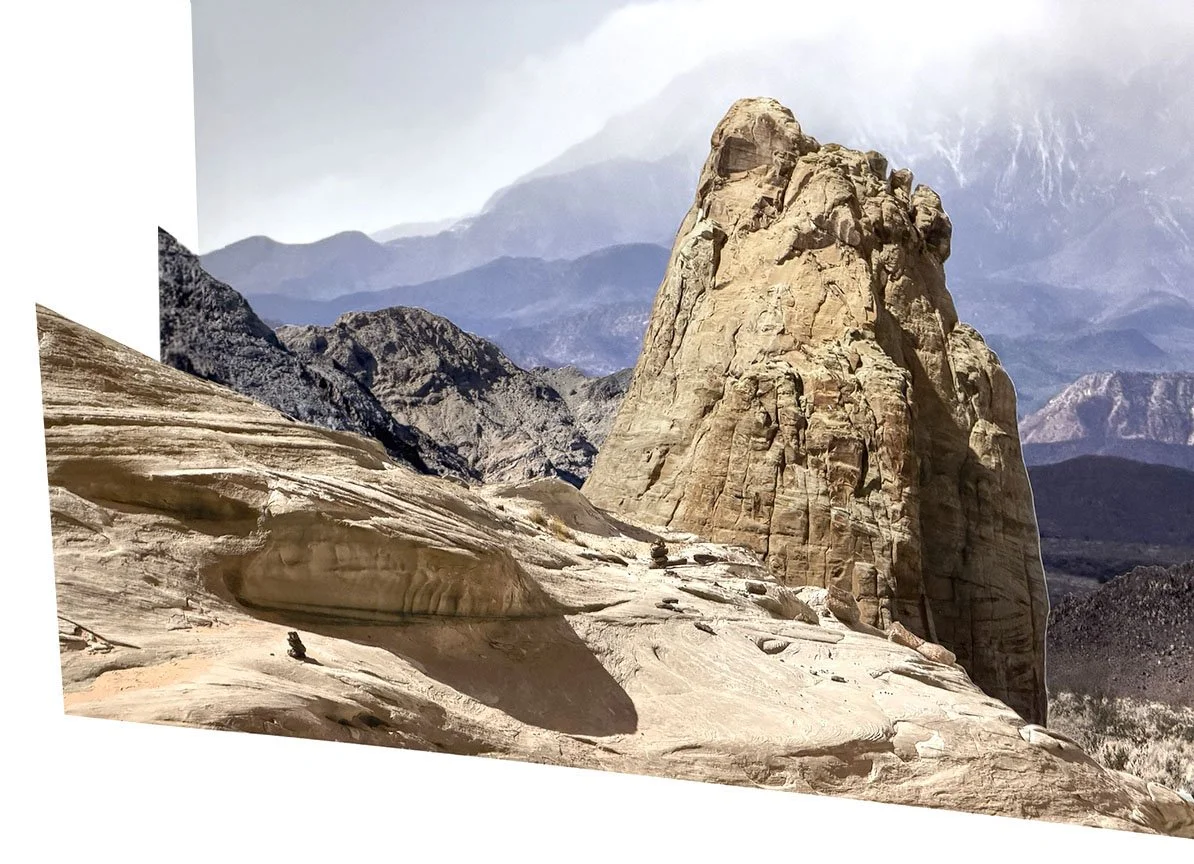
My images are created using a digital camera but they are not digital composites and are not digitally “manipulated” beyond standard tonal adjustments required for printing. They are in many cases photographs of my own photographs, cut apart and reconfigured.
“All we see is image, but we do not know of what.”
— Jean-Philippe Antoine (2)
(1) The “landscape of the mind” is a phrase Ben Tufnell uses in the introduction to In Land, Writings about Land Art and it’s Legacies,his influential collection of essays which broadened the conceptual framework for what has been categorized as Land art and Earthworks. This expanded genre includes a diverse range of works in multiple mediums that, though they defy easy labels, share a defining aspect of the original Land art movement —a direct engagement with nature or the idea of nature. “In Land art, idea, process and experience are prioritized above objecthood."
(2) From Photography, Painting and the Real; The Question of Landscape in the Painting of Gerhard Richter. Antoine underscores Richter’s own description of his landscapes as “liars” in this way: “What is staged in the landscapes is, once again, not the illusory nature of representation, but the projective quality of the idea of Nature embodied in the landscape.” In analyzing this merging of representation with idea, Antoine asserts that “It belongs to the very structure of the human gaze and makes the relationship between reality and image undecidable.”